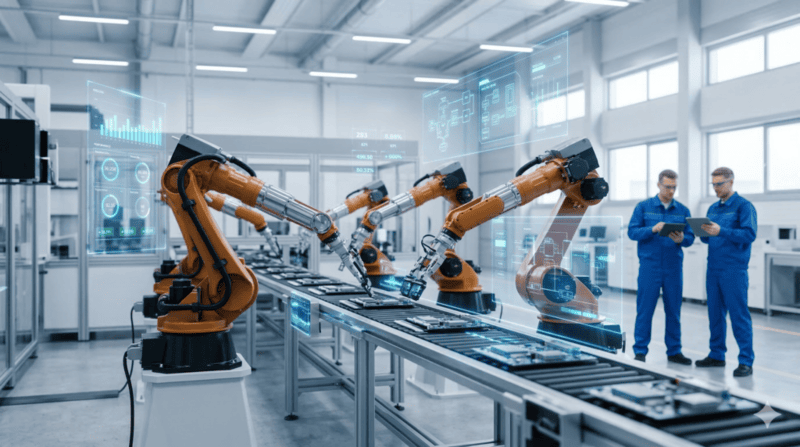
The World Robotics 2025 report, published by the International Federation of Robotics (IFR), confirms that the industrial robotics market continues to expand. In 2024, 542,076 industrial robots were installed, marking the fourth consecutive year of more than 500,000 units, and forecasts point to some 602,000 by 2027, with sustained growth rates in the coming years.
In Spain, data from the Spanish Association of Robotics and Automation (AER Automation) reflect that 5,160 installations were reached in 2024, consolidating Spain as the third European power in robotics, only behind Germany and Italy. Although Spain shows significant growth, there is still great potential for automation in sectors outside the automotive industry, which currently leads the market with more than 40% of installations.
Despite the structural growth of the market, there is a paradox in the communication of companies in the sector: while automation and industrial robotics are growing at record pace, the marketing and communication of the companies that make up this sector have not yet adapted to the speed of change.
The market: where we come from, where we are and where we’re going
Spain: sustained growth
With 5,160 units installed in 2024, Spain maintains a positive trend, exceeding 5,000 units per year for the second consecutive year. Although automotive remains the main sector, with more than 2,200 installations, sectors such as food, beverages (+25.3%) and electronics (+118%) have shown outstanding growth. Robotic density in the automotive industry remains high, but sectors such as food and electronics show great scope for automation yet to be explored.
Europe and the world: sustained growth with regional divergences
In 2024, Europe installed between 85,000 and 86,000 industrial robots (16% of the global total), with heterogeneous behavior between countries. Germany and Italy experienced declines in new installations, while Spain grew by 2.1%. Globally, China accounted for 54% of new installations, with accelerated growth. Forecasts for 2025-2027 remain positive, with strong growth in emerging markets such as China and India, and moderate acceleration in Europe.
The five technology trends defining the sector
World Robotics 2025 identifies five trends that will mark the demand and development of the sector in the coming years. They are relevant not only for those who manufacture or integrate robots, but also for those who communicate them:
- Physical, analytical and generative AI: robots integrate AI at three layers: analytical (interpretation of sensory data), physical (training in virtual environments before operating in real plant) and generative (the “ChatGPT moment” of physical robotics, according to the IFR). Robots are no longer programmed machines but systems that learn and adapt.
- Single-purpose humanoid robots: the IFR distinguishes between generalist humanoid robots developed by startups and single-task industrial humanoids focused on by traditional manufacturers, mainly in automotive. The IFR warns that “it remains to be seen whether industrial humanoids can represent a viable and scalable business case compared to existing solutions.”
- Sustainability and energy efficiency: compliance with SDGs and European environmental regulations becomes a requirement for supplier whitelisting. Robots contribute to reducing material waste and improving the output/input ratio, but are also designed with lower energy consumption of their own.
- RaaS and low-cost robotics: Robot as a Service removes the capex barrier for SMEs. Low-cost robotics caters to the “good enough” segment for low complexity applications. The IFR notes that “most manufacturing companies are SMEs” and that adoption by these companies “is still hampered by high upfront investment.”
- Response to labor shortages: The ILO confirms a structural labor shortage in global manufacturing driven by demographic change. Robotization not as a replacement but as a complement to 3D (dirty, dull, dangerous) tasks frees people for higher value activities.
The paradox of the sector: a record market, but lagging behind in marketing
Despite record growth in the industrial robotics market, the B2B Marketing Hot Trends 2025 study documents that B2B marketing capabilities in Spain are 48% mature, reflecting a disconnect between marketing and sales. This directly affects lead generation, which does not reach the sales funnel efficiently.
63% of B2B companies in Spain plan to increase their marketing spend in the coming years, with a particular focus on customer experience, omni-channel and technical content.
Marketing trends that will redefine the industrial sector
1-AEO and GEO: SEO is no longer enough
Traditional SEO is losing effectiveness in the face of AI-driven searches. Answer Engine Optimization (AEO) and Generative Engine Optimization (GEO) are key for industrial companies to appear in answers generated by AI engines like ChatGPT. Companies must generate quality technical content that answers questions with purchase intent.
2-Technical content as a strategic asset
The industrial marketing should focus on generating authoritative technical contentsuch as case studies, comparative guides and detailed analysis of real-world applications. This content not only positions companies as industry leaders, but also acts as a long-term strategic asset.
3-ABM and account intelligence: getting to the right decision-maker sooner
Account-Based Marketing (ABM) will be the most relevant strategy for the automation industry. The key is to identify target accounts and reach the right decision maker with the right message before the competition. The integration of AI and purchase intent data will enable greater personalization of messages and better conversion. personalization of messages and better lead conversion.
4-LinkedIn as the main channel for sectoral technical authority
LinkedIn remains the most effective channel for industrial B2B marketing. Companies should focus on sharing relevant technical content, such as trend analysis and real projects. Short videos with technical demonstrations will be the fastest growing format for engagement.
5-IA generative as an accelerator for technical content production
Generative AI is accelerating content production, allowing companies to create personalized messages and optimize the distribution of their content efficiently, without replacing technical knowledge, which remains crucial.
The window of opportunity is now
The automation and industrial robotics market in Spain and Europe is at its best structural moment in decades, with accelerated growth forecasts until 2027. Companies must seize this moment to transform their digital communication, as industrial marketing continues to lag behind market demand. Those companies that start building their digital technical authority today will have a significant advantage in the coming years.
Do you manufacture machinery, integrate robotic systems or distribute automation components?
At NAL3 we help companies in the sector to build a solid technical digital presence that generates qualified leads on a sustained basis. If you want to know more, contact us and tell us and tell us about your case.
